Back among barcamp nerds: my weekend in Nuremberg
People who know me know that I love barcamps.
When I first read about this event format around 2010, I was hooked right away. I really wanted to go to the barcamp in Stuttgart, back then one of the better-known barcamps near me. But it always fell on the weekend of my wife’s birthday. That went on for two or three years, until the dates finally worked out in 2012.
After my first barcamp weekend, I was thrilled. So many open people, so much exchange, and knowledge was shared so naturally. You got talking to people you had never met, jumped from topic to topic and went home at the end with a head full of new ideas.
I wanted to bring a format like that to Heilbronn as well. Around that time, together with a few fellow organizers, I founded the IT network connect.IT Heilbronn-Franken. Since 2014, I have had the honor of bringing the format to Heilbronn and of organizing and moderating many barcamps with connect.IT – with event support from our network, of course, and great support from companies in the region time and again.
When I founded my second company, Education Future, in 2018, I had less time, and later Corona tore a real gap into things. After that, I did not manage to take on the complete barcamp organization on top of everything else.
All the nicer that Barcamp Heilbronn lives on. Nicole, with whom I have worked closely and with great trust through connect.IT for many years, now organizes it together with her students at Heilbronn University. I am involved on the sidelines in a supporting role, together with my team at gravima, who by now are quite experienced in barcamps as well.
Out of Heilbronn again after years
What I had been missing: being at a barcamp outside Heilbronn myself again. Simply being a participant, meeting other people, attending sessions and seeing what happens. I had not breathed real barcamp air with the barcamp nerds for many years.
Then a longtime friend, Silke, told me she was going to the barcamp in Nuremberg. It was taking place again after a longer break. My reaction came quickly: Good idea, I’ll just come along.
While we were at it, Silke mentioned that the barcamp in Pforzheim was taking place a week later. And so it happened that I was in Nuremberg from 18 to 20 September and sat in the next barcamp in Pforzheim one week later.
There is a separate article about Pforzheim. Nuremberg first.
Wait a moment: only 30 people?
The barcamp was organized by Andreas, whom I knew from earlier barcamps and who had taken the Nuremberg barcamp back into his hands after a longer break.
At the meeting the evening before, I learned that barely 30 people had signed up. Honestly, I was quite curious how that would feel. The barcamps I had been to so far sometimes had up to 200 participants. And now 30?
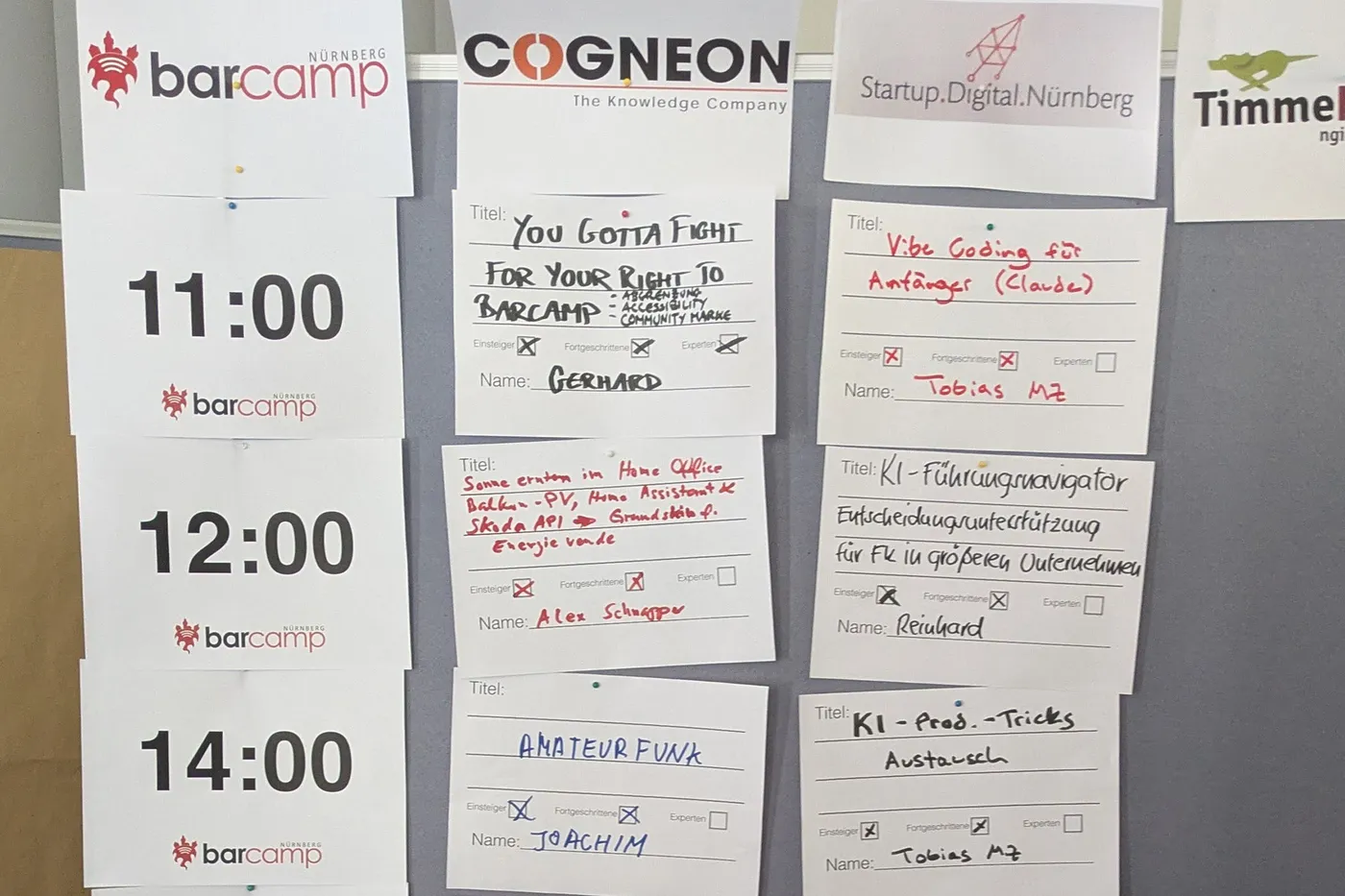
On Saturday we really were a small, cozy bunch, with only two session rooms accordingly. The topics were still very diverse, and to my delight there was quite a bit for “techie Steffen” too. Above all, you quickly noticed another advantage of the small group: you kept running into each other, conversations simply continued after a session, and after a short while you knew almost every face.
Vibe coding and building a new slide on the fly
In his session on vibe coding with Claude, Tobias gave exciting insights into how he works. What stayed with me was not only the programming, but above all how naturally AI is by now moving into entirely different workflows.
For example, he showed how he creates presentations with Claude Design. If a slide is missing, you do not necessarily have to open the presentation and start pushing layouts around yourself. Share a screenshot, give Claude the context and say, roughly: “Please build me a matching slide for this presentation from that.”
That is how people work today.
It is exactly such small examples that make me notice how quickly our everyday work is changing right now. Not at some point in a distant AI future, but in tasks we do on the computer today as a matter of course.
Typing is yesterday
In a session of his own, Andreas also showed which AI tools he now uses to work more productively. There is a good overview of AI tools on his website. My takeaway: speech is increasingly becoming the natural interface for dealing with AI.
I type quite fast with ten fingers, so for a long time I did not consider voice input particularly important. But with AI, that is changing. Instead of first formulating every thought cleanly on the keyboard, I can simply talk it through. Especially when a lot of context is needed, that is often faster and more natural.
Since Nuremberg, I actually catch myself dictating things even more often.
When “That doesn’t work” is suddenly not enough
I was also very impressed by the story of Michael. As an entrepreneur, he started rebuilding his own system landscape piece by piece with the help of AI: automating processes, replacing Shopware plugins, getting rid of isolated solutions and developing things himself that previously required external solutions.
I found his attitude especially exciting. By his account, he was told by developers more than once that certain things would not work that way. He was not willing to accept that, kept trying, and has by now digitized and automated his company to a very large extent.
And he had no great programming experience before.
Stories like this keep opening my eyes. AI of course does not automatically turn everyone into a software developer. But the hurdle to try out an idea yourself and get quite far has dropped enormously. Especially for people who are open to technology and coding and willing to dig in, entirely new possibilities arise.
And suddenly, when someone says “That doesn’t work”, it is much easier to check for yourself whether it really doesn’t.
Fortunately, a barcamp is not only sessions
A highlight, by the way, was the food. Besides delicious pizza, Andreas’s wife cooked Thai food on site on Saturday and Sunday – completely uncomplicated and super tasty. For me better than in many a Thai restaurant.
That is part of a barcamp for me too: sitting together, eating and talking on. Some of the best conversations simply do not happen in the session room.
On Sunday, almost the same crew was back. After the small group on Saturday, it actually already felt a bit like family.
This time I also brought in two sessions myself. In a small group, we worked on an idea that had come up on Saturday: How could overflowing mailboxes be brought under better control with automation and AI?
The second session was about GEO, Generative Engine Optimization. That is, the question of how visibility changes when information is no longer found only through classic search engines, but increasingly through answers from AI systems. Manuel was also working on the topic, so we simply ran the session together.
That, too, is barcamp for me: you do not have to stand up front and claim to know all the answers already. You bring a question, an experience or an idea and see together what comes out of it.
Exactly what I had been missing
Besides the sessions, it was above all the many conversations that stayed with me. Thanks, among others, to Hubert, Stefan, Gerhard, Xiller, Joachim, Elena, Reinhard and Alexander – and of course to everyone else who made this weekend so enjoyable.
After the three days, it was quite clear to me again why I like this format so much. From almost every barcamp so far, I have come home with at least one thought I had not had on my radar before. Often it is not the big talks or finished concepts, but a session, a side remark or a conversation over dinner.
And Nuremberg showed me something else: a good barcamp does not need many people. Perhaps it was precisely the small group this time that made it so personal.
Above all, I realized how much I had missed this barcamp air.
The nice thing was: one week later, it went straight on in Pforzheim.
Keep reading
Back among barcamp nerds: my weekend in Nuremberg
Only around 30 people had signed up for the barcamp in Nuremberg. From that small group I take away impressions of AI in everyday work, and the realization of how much I had missed this barcamp spirit.
What our time perspective has to do with learning and change
A video by Philip Zimbardo raised a question for me: is the promise of “later” enough when people mostly think in the present? I look at what that means for training and communication.